Project information
The Atlas Carbon Storage Hub from Shell and ATCO intends to store CO2 emissions generated in the Alberta industrial heartland region.

How Does CCS Work?
Carbon capture and storage (CCS) involves the capture of CO2 from industrial sources that would otherwise be emitted to the atmosphere. Once captured, the CO2 is purified and sent via pipeline to a storage well where it is permanently stored in a suitable and safe reservoir underground. CCS has sometimes been referred to as a new technology; however, all the technologies used in CCS have been used in varying forms in the oil and gas industry for many decades.

Where are you storing the CO₂?
The CO2 will be stored in Cambrian rock at the base of the Western Canadian Sedimentary Basin in the Basal Sandstone Unit (BSU) - a rock layer about 2 km underground.
The CO2 will be stored in the small spaces [pores] within the sandstone. If you imagine the hard, round sand grains like the balls in a ball pit or gumball machine, they can only pack so close together, there is always space left between them – those spaces also exist on a smaller scale between the grains of sand in the rock.
There is already salt water that sits within the spaces between the sand grains. These spaces allow for the flow of a liquid within the rock and make up the storage reservoir. All those spaces combined make up the “container.”
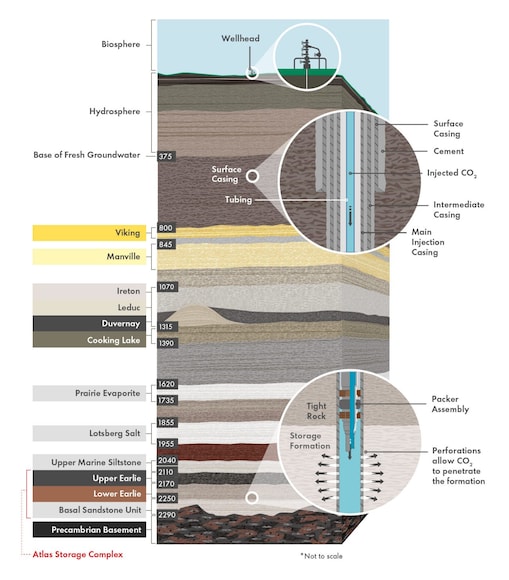
Accessible infographic description
Accessible infographic description
This diagram illustrates the process of carbon capture and storage detailing how carbon dioxide captured from industrial processes is injected deep underground for permanent storage.
Depicting a geological cross-section the diagram shows how a wellhead on at surface level from which an injection well is drilled through various geological layers, including the biosphere, hydrosphere, and different rock formations like shale and sandstone.
The image also provides depth markers for the different geological layers, with the deepest layer being the Precambrian Basement at 2290 meters.
A magnified illustration from a point just below the shallow layers depicts how the injection well is constructed with multiple layers of steel casing and cement (surface, intermediate, and main injection) to ensure integrity and prevent leakage while tubing safely transports the CO₂ down through the earth’s rock.
The shallow layers shown are labelled Biosphere and Hydrosphere with the Base of Fresh Groundwater pinpointed at approximately 375 meters depth.
The intermediate layers shown are labelled Viking, Manville, Ireton, Leduc, Duvernay, and Cooking Lake formations.
The deep layers shown are labelled Prairie Evaporite, Lotsberg Salt, and various Cambrian-era siltstone and sandstone layers leading down to the Precambrian Basement at around 2290 meters depth.
The carbon dioxide storage is shown as being within Basal Cambrian Sandstone between 2250-2290 meters depth.
At the storage point, a magnified illustration shows how the CO2 is delivered via a packer assembly and tubing with perforations at the bottom of the well enabling the injected CO2 to penetrate the target storage formation effectively through perforations.
A tight rock layer above of Lower Marine Sandstone, prevents the CO₂ from escaping.
Want to know more about CO₂ storage?
What makes this area ideal for CO₂ storage?
What makes this area ideal for CO₂ storage?
The Basal Sandstone Unit (BSU) is an ideal reservoir for CO2 storage. While it covers much of central Alberta into Saskatchewan, the BSU in this region is very good for storage. The area also has multiple natural seals to keep the CO2 in the storage reservoir. While we look to keep the storage near our facility to minimize surface disturbance, we also need to store the CO2 in the safest possible locations.
While the BSU is an excellent reservoir to store CO2, we cannot put all the CO2 in one location, which is why we have a large Area of Interest (AOI). We are evaluating storage in several different areas within the AOI, including the area around the Shell Scotford facility where we have planned the first phase of our storage project.
Is underground storage of CO₂ safe? How do you know the CO₂ will remain underground?
Is underground storage of CO₂ safe? How do you know the CO₂ will remain underground?
This is a world-class place to safely store CO2. The chosen sandstone rock formation called the Basal Sandstone Unit (BSU) is located 2 km deep underground and sits below a high-quality shale seal. Additionally, multiple layers of salts and other sealing and baffling rock separate the storage zone from the surface. We monitor the CO2 and pressure changes to confirm the CO2 and reservoir are behaving as expected in the rock formation.
The Atlas Carbon Storage Hub includes a robust Measurement, Monitoring and Verification (MMV) plan. It is a monitoring plan to confirm that the CO2 remains securely contained. Monitoring begins before injection starts to gather baseline data against which future results can be compared to demonstrate that there are no adverse impacts. The monitoring conducted is designed to provide early warning in the unlikely event CO2 is detected outside of the storage formation.
What is Measurement, Monitoring, and Verification (MMV)?
What is Measurement, Monitoring, and Verification (MMV)?
Measurement, Monitoring and Verification is regulatory requirement in Alberta that provides confidence to stakeholders that the CO2 is behaving as expected and is not leaking. MMV utilizes a combination of technologies that collect data over time along our wells and in the atmosphere, hydrosphere, and geosphere (rocks) to demonstrate the secure storage of CO2.
What types of monitoring is Atlas planning?
What types of monitoring is Atlas planning?
Atlas will use a variety of monitoring technologies over time (before, during, and after injection) to demonstrate the secure storage of the CO2. The technologies proposed include:
Water Well Testing: project groundwater wells and some landowner groundwater wells near the injection pads will be tested prior to and during injection to demonstrate that there are no adverse impacts to drinking water.
Seismicity Monitoring: sensitive monitors will be installed in select monitoring wells and on the surface to detect any seismicity in the area. This technology is sensitive enough to measure seismicity orders of magnitude smaller than can be felt at surface.
InSAR: satellite images will be collected prior to and during injection to monitor ground elevation changes.
Reservoir Performance: downhole pressure and temperature monitoring at the injection wells will be used to monitor reservoir performance.
Well Integrity: continuous annular pressure monitoring and annual packer isolation tests will be performed to confirm isolation of the storage complex.
The monitoring program will be updated and adapted over time as data is collected or as new technology emerges.
What happens if the CO₂ leaks?
What happens if the CO₂ leaks?
Global storage projects store several millions of tonnes of CO2 annually in deep saline formations, demonstrating that it is safe and effective. If we consider the use of CO2 in enhanced oil recovery projects, they have been operating safely for decades.
In the case of water close to the surface like water wells or lakes, there are many plans in place to ensure CO2 does not leak into these. For example, the chosen sandstone rock formation 2 km deep underground sits below a high-quality shale seal. Additionally, multiple layers of salts and other sealing and baffling rock separate the storage zone from the surface. Each layer acts as its own seal to the layer below to ensure the CO2 stays in the rock formation in which it’s injected. As additional support, we also have extensive monitoring requirements that ensure we know how and where the CO2 is moving the subsurface rock formation.
CCS projects - including the Quest project at the Shell Scotford complex near Fort Saskatchewan, have been operating without leaks for years around the globe. The Quest facility, which opened in 2015, has a proven track record for safe and reliable operations. Quest has shown that the Basal Sandstone Unit (BSU) is an exceptional storage reservoir for safe and permanent CO₂ storage.

You may also be interested in